


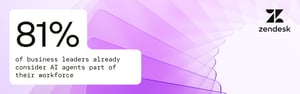
AI in customer service can now do more than write replies. It can carry out work that once took many manual steps, around the clock. That makes it closer to a team member than a tool. And a team needs managing.
Managing an AI workforce means giving each AI agent a clear job, the right knowledge and instructions, and a defined point at which a person steps in.
Here is what we see when we help customers build an AI workforce with Zendesk, and where our experience tells us it is heading.
First, four terms we use throughout
- Human agents are the people on your support team.
- AI agents interact directly with customers. Beyond answering questions, they can take steps to resolve requests when the necessary systems and permissions are in place.
- Zendesk Custom Agents are AI specialists built for defined tasks or business processes. They work alongside customer-facing AI agents and human teams. They are not human roles.
- Fixed flows follow predefined rules and steps, without AI reasoning deciding the path.
What we see when teams put AI to work
1. Onboard AI like a new colleague
Start with what a new colleague needs on day one: clear and current information, the right instructions, and access to the systems the job requires. Give your AI agent only the access you can validate and monitor.
Plugging in one general AI and letting it run is not enough. A plausible answer is not necessarily the answer your business needs. As our CX Consultant, Saskia Clappers, puts it:
"If you just let it go, it will do whatever it thinks, probability-wise, is the right decision. But that can be completely wrong from what you need or want."
Help centre content that makes sense to an experienced human colleague may leave too much unsaid for an AI agent. A practical start is to identify common questions your team can resolve in a single answer, turn those answers into clear help centre articles, and let your AI agent handle those first.
2. Give each AI agent a specific job
A good human team mixes generalists with specialists. An AI workforce works the same way.
A customer-facing AI agent can handle a broad range of requests. Custom Agents take on defined tasks or processes that need business-specific knowledge and instructions. The task may be complex, but its purpose should be clear.
Zendesk's Specialised Agents, which include ready-made Industry Agents and the Custom Agents businesses build, follow this idea: different AI specialists for different kinds of work.
The starting point is the job you need done, not the number of AI agents you can deploy.
3. Decide what AI decides, and what stays fixed
Fixed flows follow predefined rules. AI agents interpret the context of a request and choose a next step within the instructions and permissions they have been given.
Where a process must follow the same steps every time, use a fixed flow. Where requests need interpretation, let an AI agent reason within clear boundaries. Choosing between them, task by task, is part of managing your AI workforce.
4. Design the handover to people
A good handover starts with two decisions: what your AI agent handles on its own, and exactly when it passes the customer to a human agent.
One of our projects involved WhatsApp support for a consumer digital service:
- Before: every payment or cancellation question went straight to a human agent, even straightforward ones.
- After: the AI agent checked the help centre first. It passed the customer to a human agent if it found no answer or the problem continued.
The point is not to keep people out of the conversation. It is to know when they need to join it.
Where we expect AI workforce management to go next
A role or team will take ownership of the AI workforce
AI decisions bring support, IT, legal, and governance teams together. None has the full picture alone. IT understands the infrastructure. Support understands the service processes. Legal and governance teams bring their own responsibilities.
We expect a role or team to emerge across these functions, with overall responsibility for how the AI workforce is set up, checked, and rolled out.
Human work will shift towards improving the system
As AI takes on repetitive work, we expect human agents to spend more time improving processes, writing the instructions their AI colleagues work from, and handling complex or sensitive cases that need empathy.
In our view, service quality will depend less on capacity alone and more on smooth processes and well-supported teams. The shift is not simply about jobs disappearing. It is about how roles change as people and AI work together.
Teams invited to shape where AI helps will have more reason to trust it than teams simply told it is coming.
Some moments will still need a person
AI can offer speed and consistency. People bring human judgement, empathy, and creativity. Good service design recognises which moments need a person.
Managing an AI workforce means making room for both.
The takeaway
The teams that get the most from AI will not be the ones with the most AI agents. They will be the ones that know:
- What each AI agent is for.
- Who is responsible for it.
- When a person steps in.