


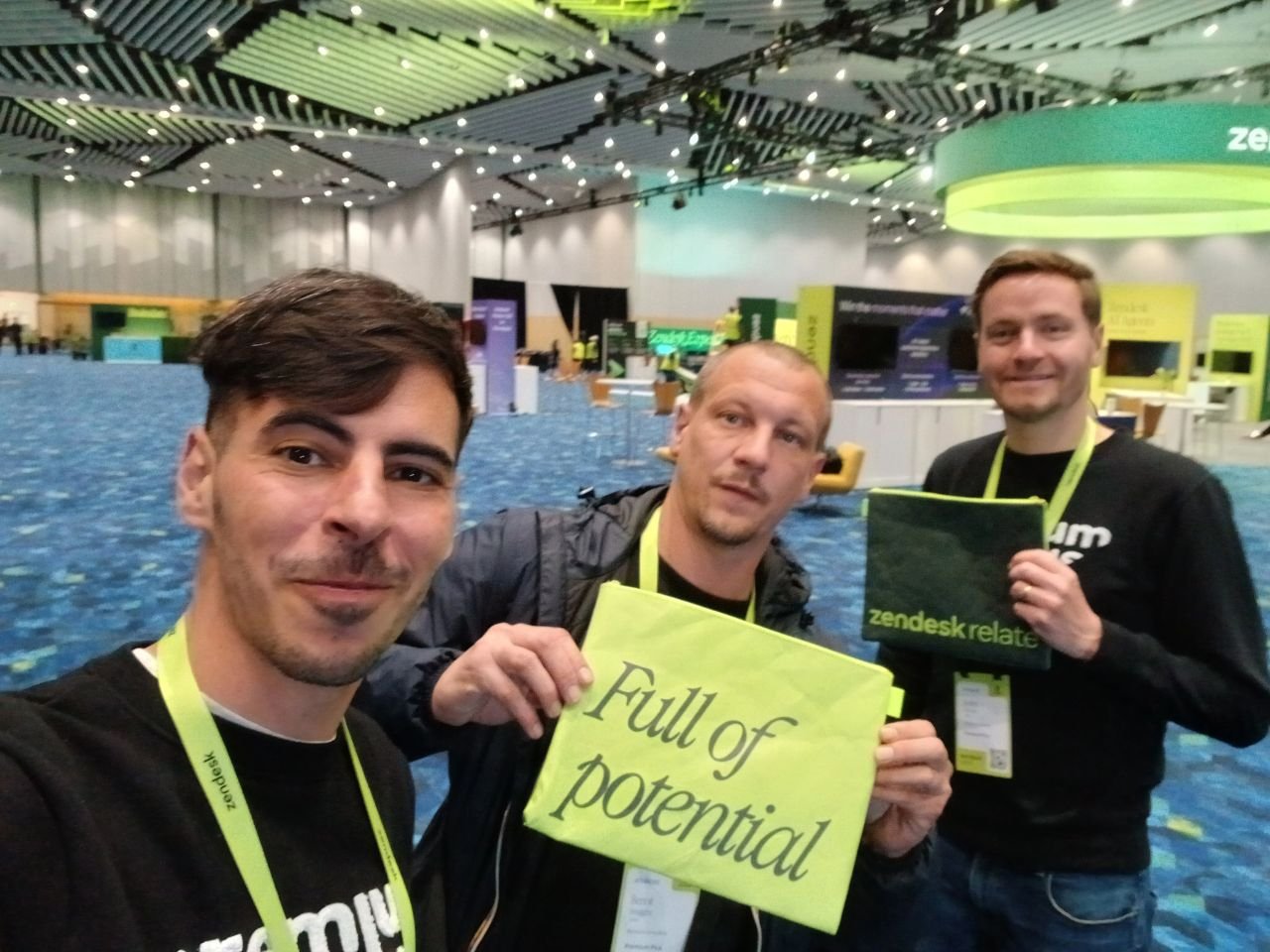
Zendesk Relate 2026 made one thing very clear: Zendesk is no longer positioning AI as a support feature.
It is positioning AI as the operational layer of the entire service organisation.
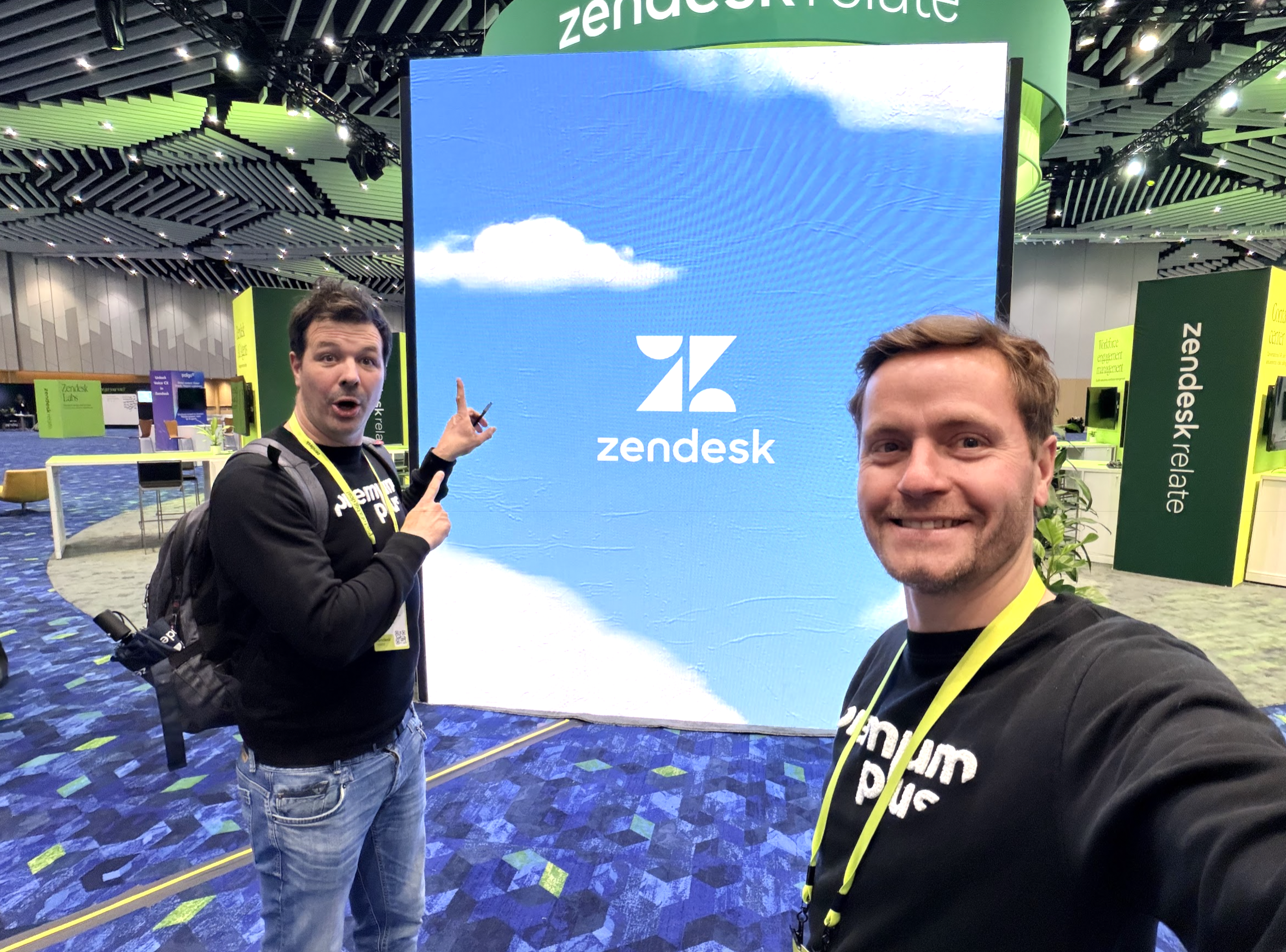
After attending Relate in person, the biggest takeaway for us was not a single announcement or flashy demo. It was the broader direction Zendesk is taking with what it now calls the Autonomous Service Workforce.
Zendesk is moving beyond:
- chatbots
- isolated copilots
- ticket automation
towards a connected system where:
- AI agents
- copilots
- workflows
- knowledge
- analytics
- governance
- humans
all continuously improve together.
This is the foundation of Zendesk’s new Resolution Platform and its Resolution Learning Loop™.
And operationally, this is probably the biggest platform shift we’ve seen from Zendesk in years.
The Main Theme of Relate 2026: Continuous Improvement
Throughout the event, Zendesk repeatedly focused on one core idea:
Every interaction should improve the system.
That means:
- AI agents learning from resolutions
- copilots identifying operational gaps
- analytics surfacing root causes
- knowledge improving continuously
- workflows becoming more autonomous over time
Zendesk calls this the Resolution Learning Loop™.
Instead of AI being a static configuration project, Zendesk is building a platform where automation continuously evolves based on operational data.
As Ignacio de la Llave put it during the event:
“The biggest change is that Zendesk is no longer treating AI as a feature. They’re treating resolution itself as the product.”
Zendesk Introduced the Autonomous Service Workforce
The headline announcement at Relate was Zendesk’s new vision for an Autonomous Service Workforce.
The idea is simple:
AI agents, copilots, and humans operate together inside a single service system.
This includes:
- customer-facing AI agents
- internal employee service agents
- AI copilots for admins and analysts
- automated workflows
- orchestration across external systems
The important detail here is that Zendesk is trying to unify all these layers operationally.
Previously, many organisations had:
- separate AI tools
- disconnected analytics
- fragmented knowledge systems
- manual workflow orchestration
- isolated automation initiatives
Zendesk is now attempting to centralise these into one operational model.
For many support organisations, that could significantly reduce complexity.
Automation Potential May Become One of the Most Important Admin Features
One of the most interesting announcements was Automation Potential.
This new dashboard shows:
- automation opportunities
- processes ready for AI
- workflows blocked by knowledge gaps
- operational bottlenecks
This is important because most organisations struggle to answer basic operational questions like:
- What should we automate first?
- Why are AI agents failing?
- Which workflows generate the most repetitive work?
- Where are our knowledge gaps?
Automation Potential starts operationalising those decisions.
Benoit Smagghe summarised it well after one of the product sessions:
“A lot of teams still build automation based on assumptions. Zendesk is now trying to bring operational evidence directly into the decision-making process.”
For Zendesk admins and CX leaders, this could become one of the most valuable optimisation tools in the platform.
Custom action makes Zendesk AI more flexible, scalable and maintainable
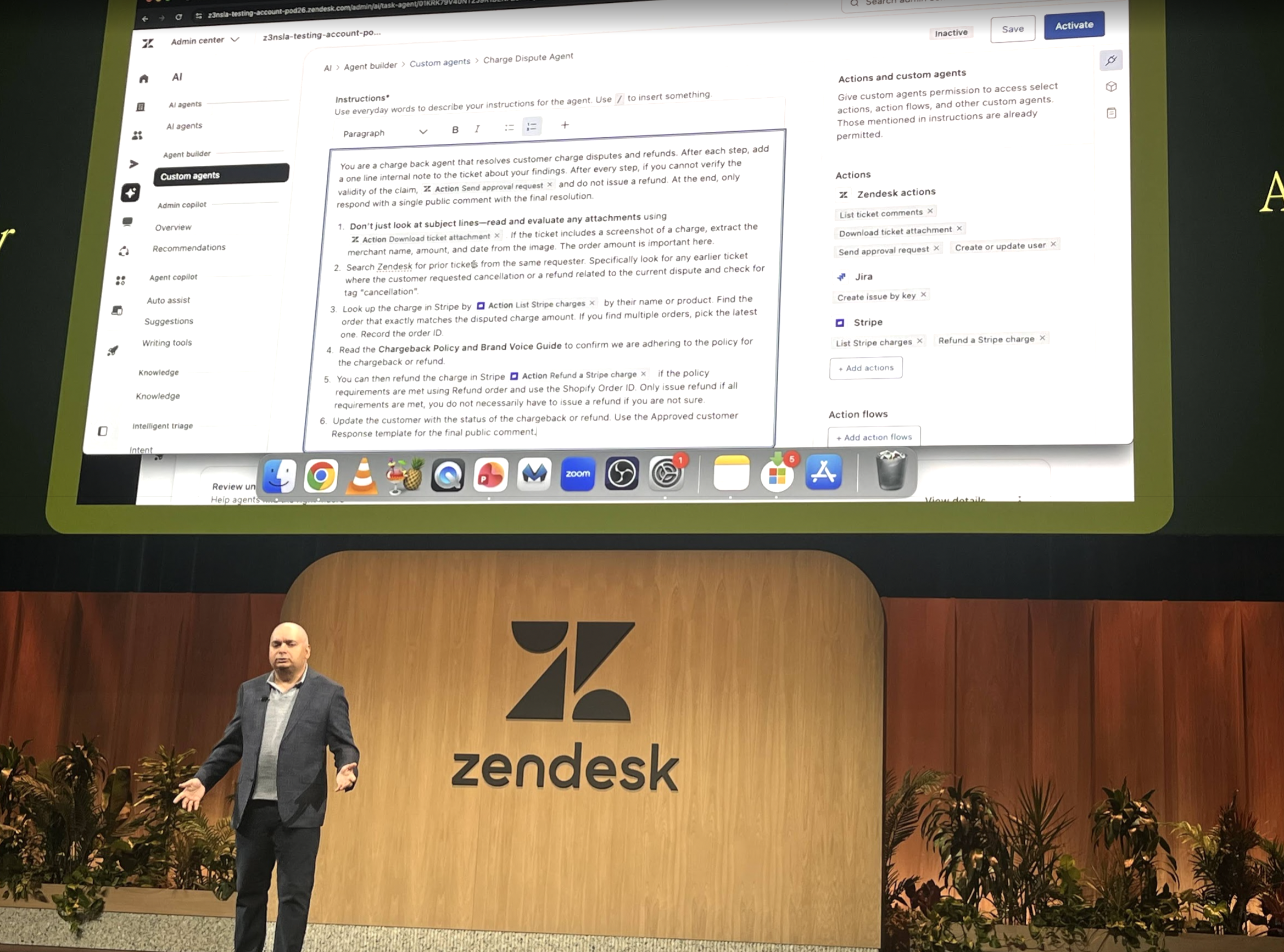
Zendesk also announced the new Custom Agent Builder.
This allows teams to create specialised AI agents using natural language instead of complex development work.
These agents can:
- handle policies and exceptions
- manage back-office workflows
- delegate tasks to other agents
- coordinate with human teams
This is a major evolution compared to traditional support bots.
Historically, AI struggled with:
- edge cases
- operational logic
- multi-step workflows
- internal processes
Zendesk is now clearly moving toward more agentic behaviour.
Operationally, though, this also increases the importance of governance.
The more autonomous AI becomes, the more organisations will need:
- workflow oversight
- escalation design
- testing frameworks
- permission management
- operational ownership
This is where many companies will still need experienced Zendesk partners to help structure scalable implementations.
Copilots Expanded Across Every Operational Role
Zendesk also expanded its Copilot strategy significantly.
At Relate, Zendesk announced:
- Admin Copilot
- Knowledge Copilot
- Analyst Copilot
- enhanced Agent Copilot capabilities
This reflects another major strategic shift:
AI is no longer only supporting agents.
It is increasingly supporting operations teams themselves.
Admin Copilot
Admin Copilot identifies:
- workflow inefficiencies
- operational spikes
- routing issues
- optimisation opportunities
It can also recommend and configure workflow and routing changes automatically.
Knowledge Copilot
Knowledge Copilot monitors:
- knowledge health
- content gaps
- missing documentation
- article improvement opportunities
This is particularly important because AI quality is now directly linked to knowledge quality.
Analyst Copilot
Analyst Copilot introduces natural-language analytics focused on:
- trends
- root causes
- operational recommendations
Combined with Zendesk’s new analytics infrastructure following the HyperArc acquisition, this moves Zendesk toward much more accessible operational intelligence.
For many support leaders, this could reduce dependency on dedicated BI resources for day-to-day analysis.
Zendesk Is Expanding Beyond Customer Support
Another major theme at Relate was employee services.
Zendesk announced new Employee Service AI agents built for:
- Slack
- Microsoft Teams
- internal support workflows
This reflects Zendesk’s growing investment in ITSM and internal service management.
The goal is clearly to position Zendesk as:
- a customer service platform
- an employee service platform
- an operational workflow platform
For organisations already using Zendesk externally, this creates a much stronger internal expansion story.
Voice AI and Omnichannel AI Are Becoming Native
Zendesk also announced:
- native Voice AI agents
- expanded omnichannel AI support
- multilingual AI interactions across 60+ languages
One particularly important detail is continuity.
Zendesk is increasingly focused on preserving context across:
- messaging
- voice
- internal workflows
That continuity layer is critical for enterprise support operations.
Without it, omnichannel usually becomes fragmented channel management rather than true operational orchestration.
Knowledge Connectors Continue Expanding
Zendesk also expanded its external knowledge ecosystem with connectors including:
- SharePoint
- Google Drive
- Notion
- Confluence
- Contentful
- Document360
This matters because many organisations do not centralise knowledge inside Zendesk itself.
Instead, knowledge is often distributed across multiple systems.
Zendesk is trying to make that fragmentation operationally usable for AI agents and copilots.
But this also creates a new challenge:
Knowledge governance becomes even more important.
As Benoit noted during one of the AI sessions:
“More connected knowledge is powerful, but only if organisations know which content they can trust operationally.”
MCP Support May Become One of the Most Important Technical Announcements
One announcement that may fly under the radar for non-technical audiences was Zendesk’s support for the Model Context Protocol (MCP).
This allows Zendesk AI agents to connect with external tools and systems more intelligently.
Operationally, this means AI agents may increasingly:
- trigger actions
- orchestrate workflows
- interact with external systems
- coordinate across platforms autonomously
This moves Zendesk much closer to becoming an AI orchestration layer rather than simply a ticketing platform.
For technical teams, this is one of the most strategically important announcements from Relate 2026.
Zendesk Expert Note — Ignacio de la Llave
A common misconception is that MCP is only relevant for AI agents. In reality, it also plays an important role for copilots and broader AI orchestration use cases.
It’s also important to understand that Zendesk’s MCP approach has two separate components with different objectives:
- MCP Client → Allows Zendesk to connect with external platforms and systems to trigger actions, retrieve context, and orchestrate workflows.
- MCP Server → Allows external systems and platforms to interact with Zendesk, trigger actions, and retrieve Zendesk context and data.
This distinction is important because it positions Zendesk both as a consumer of external AI capabilities and as an operational AI layer other systems can connect to.
What This Means for Zendesk Customers
Relate 2026 confirmed that Zendesk is entering a new operational phase.
The platform is increasingly built around:
- continuous improvement
- operational intelligence
- AI orchestration
- workflow autonomy
- knowledge-driven automation
But these capabilities also introduce new complexity.
The organisations that succeed with Zendesk AI will likely not be the ones deploying the most features.
They will be the ones with:
- strong governance
- scalable workflows
- high-quality knowledge
- operational ownership
- continuous optimisation processes
At Premium Plus, these are exactly the areas we increasingly help customers with:
- AI strategy
- Zendesk optimisation
- automation design
- knowledge governance
- workflow architecture
- AI agent implementation
- operational scalability
Because the challenge is no longer simply “adding AI”.
The challenge is building a service operation that can continuously improve over time.

Final Thoughts
Zendesk Relate 2026 was not about isolated product announcements.
It was about Zendesk redefining what service operations could look like in an AI-native environment.
The biggest shift is this:
Zendesk is moving from helping teams manage tickets…
to helping organisations operate an autonomous resolution system.
That is a much bigger transformation than chatbot automation.
And over the next few years, it will likely change how support organisations design operations entirely.
Ready to Understand What Zendesk AI Could Actually Improve in Your Environment?
Most teams already have the data, workflows, and support volume needed to benefit from AI.
The difficult part is usually:
- identifying the right automation opportunities
- structuring knowledge correctly
- designing scalable workflows
- avoiding operational complexity as AI expands
That’s where experienced Zendesk strategy and implementation support makes the difference.
At Premium Plus, we help organisations turn Zendesk AI capabilities into practical operational improvements — from AI agent design and automation strategy to knowledge governance and workflow optimisation.
Whether you are exploring AI for the first time or trying to scale an existing Zendesk environment, we’re happy to help you assess what makes sense for your teams.