



Zendesk AI agents that actually reduce tickets
Automate repetitive customer questions, save agent time, and deliver faster support using Zendesk AI Agents. Designed, implemented, and optimised by Zendesk experts.
Up to 80% automation · measurable deflection · built by Zendesk experts
1,000+ Zendesk projects delivered


What AI agents actually do
AI agents are autonomous bots that answer customer questions without human involvement. They pull from your knowledge base, understand intent, and respond 24/7. But they're only as good as your content.
Most companies overestimate what AI can handle and underestimate the content work required. Before deploying AI agents, you need clean documentation, structured answers, and realistic expectations about what questions AI can reliably solve.
When AI agents make sense
Hundreds of repetitive questions that follow predictable patterns
Customers expect instant answers outside business hours
Clear, structured content that AI can reliably reference
Your blueprint for successful Zendesk AI agents
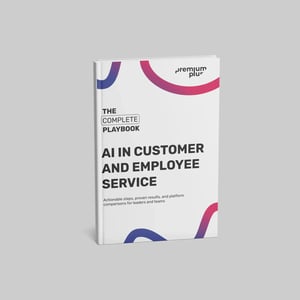
In The Complete AI in Customer and Employee Service Playbook, you’ll learn how to:
-
Spot the journeys AI can safely automate
-
Design AI experiences for both customers and employees
-
Grow from pilot to scalable, reliable automation
From first relief to real scale with AI agents
Grow automation at a pace your team and customers trust, all the way to 80% resolution and beyond.
A calmer start for your support team
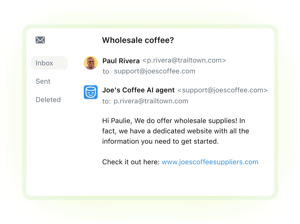
The first step often feels like immediate relief. AI Agents take over the questions your team answers every single day. Customers get quick, clear responses without waiting.
For agents, the noise drops. Less repetition. More space to focus on conversations that actually need human attention. And everything sounds like you, not like a bot.
One conversation, fully resolved
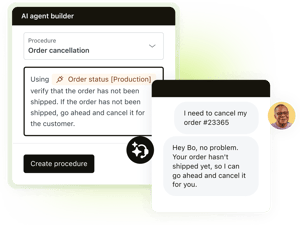
As AI matures, the experience changes. Customers no longer bounce between steps or people. The AI understands the intent, stays in the conversation, and guides it all the way to a clear outcome.
For customers, it feels simple and natural. For your team, it means fewer interruptions and far less manual follow-up during the day.
Confidence built on insight
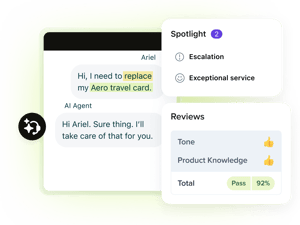
When AI becomes part of daily service, confidence matters. You see where the AI performs well and where it needs refinement. Not based on assumptions, but on real interactions.
By continuously improving, reliability increases. Internally, AI feels less like a black box and more like a trusted teammate that keeps learning.
How we implement AI agents
Content-first approach to autonomous resolution
Review and restructure your knowledge base so AI has clear, reliable source material
Identify which questions AI can reliably handle vs which need human judgment
Create structured responses for common scenarios so AI delivers consistent quality
Define when AI should hand off to humans — better to escalate early than give wrong answers
Connect to order systems, CRM, billing platforms so AI can pull real-time data
Monitor resolution rate, accuracy, customer satisfaction, and continuous improvement
See what our clients say about AI implementation
agents begged to keep AI.
"When the AI trial ended, my agents begged me to keep this feature. Working with the right partner is crucial to speed up decisions on such a solution as AI."
Guillaume Bénoit
Head of Customer Satisfaction | E.Leclerc
we now handle fewer than 50 tickets per day.
"We’ve built a strong foundation with Zendesk and Premium Plus, but we’re just getting started. AI and automation will help us scale efficiently while keeping customer experience at the core of everything we do."
Frederic Schroyens
Chief Digital Officer | Jims Fitness
BSAT soared from 50% to 100% in four months.
"Premium Plus was great at responding to challenges and diving into our AI needs. We also had an update project to upgrade our account to use AI. Although our use case is tricky, all was set up after just two weeks."
Vicky Chandler
Head of Customer Success & Support | BrightLocal
thorough AI explanation, great collaboration.
"The explanation of AI was thorough in addressing the needs expressed and the implementation of the project. There was a very good exchange with Benoit throughout the process."
Salma Palpita
Responsable service clients | INDIGO Group
flexible partner for complex Zendesk projects.
"The project involved defining and assessing feasibility in relation to our workflow. There was a good presentation of Zendesk and the Premium Plus offer. Great adaptability, readjusting deadlines and deliverables."

Alexandre Lavery
Support Service Manager | Germitec
Frequently Asked Questions
Depends entirely on question types. For simple lookups (order status, account info), 60-80% is achievable. For complex product questions or troubleshooting, 20-40%. Overall, expect 30-50% deflection if you have good content and realistic scope. We help you identify which questions AI can reliably handle.
No. AI agents handle repetitive, low-complexity questions so human agents can focus on complex issues that require judgment, empathy, or problem-solving.
Pilot: 6-8 weeks. Full deployment: 12-16 weeks. Most of that time is content preparation, auditing knowledge base, restructuring articles, creating answer templates. The actual AI configuration is fast; content quality takes time.
That's why we start with content audit and pilot testing. We identify which questions AI can reliably handle, create structured answers, and set conservative escalation triggers. If AI isn't confident, it escalates to a human. Better to hand off early than give incorrect information.
For basic AI agents, the standard AI add-on works. Advanced AI adds better intent recognition, custom training on your past tickets, and more sophisticated escalation logic. We'll assess your needs and recommend the right tier during discovery.
We track deflection rate (% tickets resolved without human), resolution accuracy (CSAT for AI interactions), escalation rate, and cost savings. The goal isn't maximum automation. It's reliable resolution for the questions AI can truly handle.
Let's analyse your ticket volume, identify which questions AI can handle reliably, and build a content-first implementation plan.


